
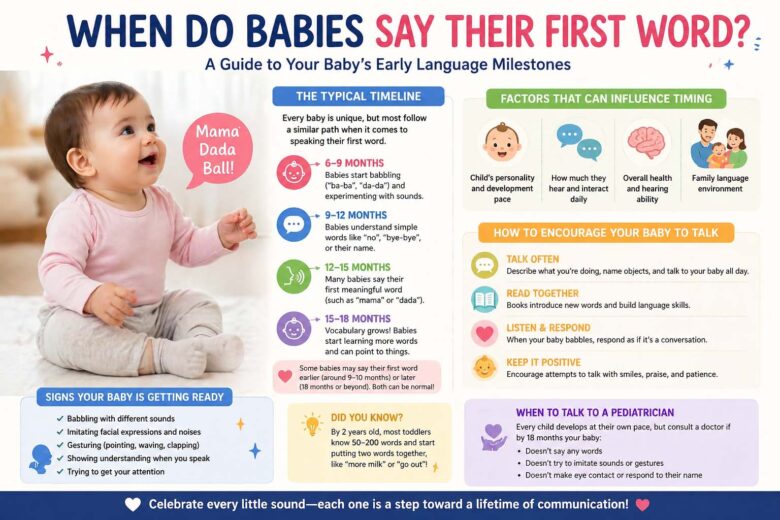
When Do Babies Say Their First Word? A Parent’s Guide to Early Speech
Parents often wonder when do babies say their first word because those early sounds are exciting milestones. Hearing a baby clearly say “mama,” “dada,” or another meaningful word can feel magical. Every child develops at their own pace, but there are common speech and language patterns that help parents understand what to expect. Some babies talk earlier, while others take more time before using real words consistently. Knowing the normal timeline can reduce stress and help families support communication in healthy ways. Families balancing parenting with travel may also research the best places to travel with kids.
Understanding Early Language Development
Before speaking, babies spend months learning how language works. They listen to voices, study facial expressions, notice tone changes, and practice making sounds. Crying is the first form of communication, followed by cooing, babbling, and repeating sounds like “ba-ba” or “da-da.” These early sounds are important because they build the muscles and coordination needed for speech.
Most babies begin understanding words before they can say them. A child may respond to their name, smile when hearing a familiar voice, or look toward a favorite toy when it is mentioned. Receptive language, which means understanding words, often develops before expressive language, which means speaking words aloud.
When Do Babies Usually Say Their First Word
Many parents ask when do babies usually say their first word because they want to know if their baby is on track. A real word is more than random babbling. It is a sound used consistently to mean something specific. For example, saying “ba” every time they see a bottle may count as a word.
Some babies may say a word at 9 months, while others may not until 15 months. Both situations can still be normal depending on overall development. What matters most is steady progress in communication, attention, and interaction.
Why Some Babies Talk Earlier Than Others
There is no single answer to when do babies say their first word because each child is unique. Several factors can influence speech timing. Personality can play a role, as some babies are more observant and quieter while others are highly vocal. Family interaction also matters. Babies who hear regular conversation, songs, and reading often have rich language exposure.
Birth history, hearing ability, and developmental differences can also affect speech milestones. Bilingual households may notice babies mixing sounds or taking time to separate languages, but this is usually normal and not harmful. In fact, children can successfully learn multiple languages from an early age.
When Do Babies Typically Say Their First Word
Another common question is when do babies typically say their first word. Typically, babies begin with simple words connected to daily life. Common first words include mama, dada, hi, bye, no, ball, dog, or milk. These words are easier because they are heard often and connected to meaningful experiences.
By around 12 months, many babies may say one or two words clearly. By 18 months, vocabulary often expands quickly. A child who once said only one word may suddenly learn many new words in a short period. This stage is sometimes called a language burst.
Signs Your Baby Is Getting Ready to Talk
Even before a first word appears, babies show signs that speech is coming soon. They may imitate sounds, point to objects, wave goodbye, or use gestures to communicate wants and feelings. They often babble with changing tones that sound almost like conversation.
If your baby looks at you when you speak, responds to familiar names, and enjoys social interaction, these are encouraging signs. Communication is much more than spoken words. Gestures, eye contact, and listening skills all support later speech success.
When Do Most Babies Say Their First Word
Parents also search when do most babies say their first word to compare their child with others. Most babies say their first recognizable word close to their first birthday, though the exact month varies. Some children are walkers before talkers, meaning they focus more on movement first. Others speak early and move later. Development does not happen in the same order for every child.
Comparisons with friends, siblings, or online stories can create unnecessary worry. One child may talk at 10 months and another at 14 months, yet both can become strong communicators later. Looking at the whole child is more helpful than focusing on one date. As children grow, parents planning future travel may also ask how old do you have to be get a hotel room.
How Parents Can Encourage First Words
The best way to support speech is through warm, everyday interaction. Talk to your baby during routines like feeding, dressing, and bath time. Describe what you are doing and name common objects. Repeat words clearly and naturally. If your baby points at a cup, say “Cup! You want the cup.” A comfortable Saco de Dormir may also become part of a baby’s bedtime routine.
Reading books daily is another powerful habit. Babies love repetition, rhythm, and pictures. Singing songs and nursery rhymes also supports listening and memory skills. Face-to-face play helps babies watch mouth movements and learn sound patterns.
When Do Babies Say Their First Word Usually
Many caregivers still wonder when do babies say their first word usually because they want reassurance. Usually, babies produce their first meaningful word around 12 months, but a range of several months before or after can still be normal. If your baby is not speaking yet but is babbling, pointing, understanding simple requests, and socially engaged, progress may still be happening.
When to Speak With a Pediatrician
Sometimes professional advice can be helpful. If a baby rarely babbles by 9 months, does not respond to sounds, has limited eye contact, or says no words by around 15 to 18 months, it may be wise to discuss concerns with a pediatrician. Hearing checks and speech evaluations can identify issues early and provide support if needed.
Final Thoughts
For many babies, it happens between 10 and 14 months, with around 12 months being common. Some speak earlier, and some later.